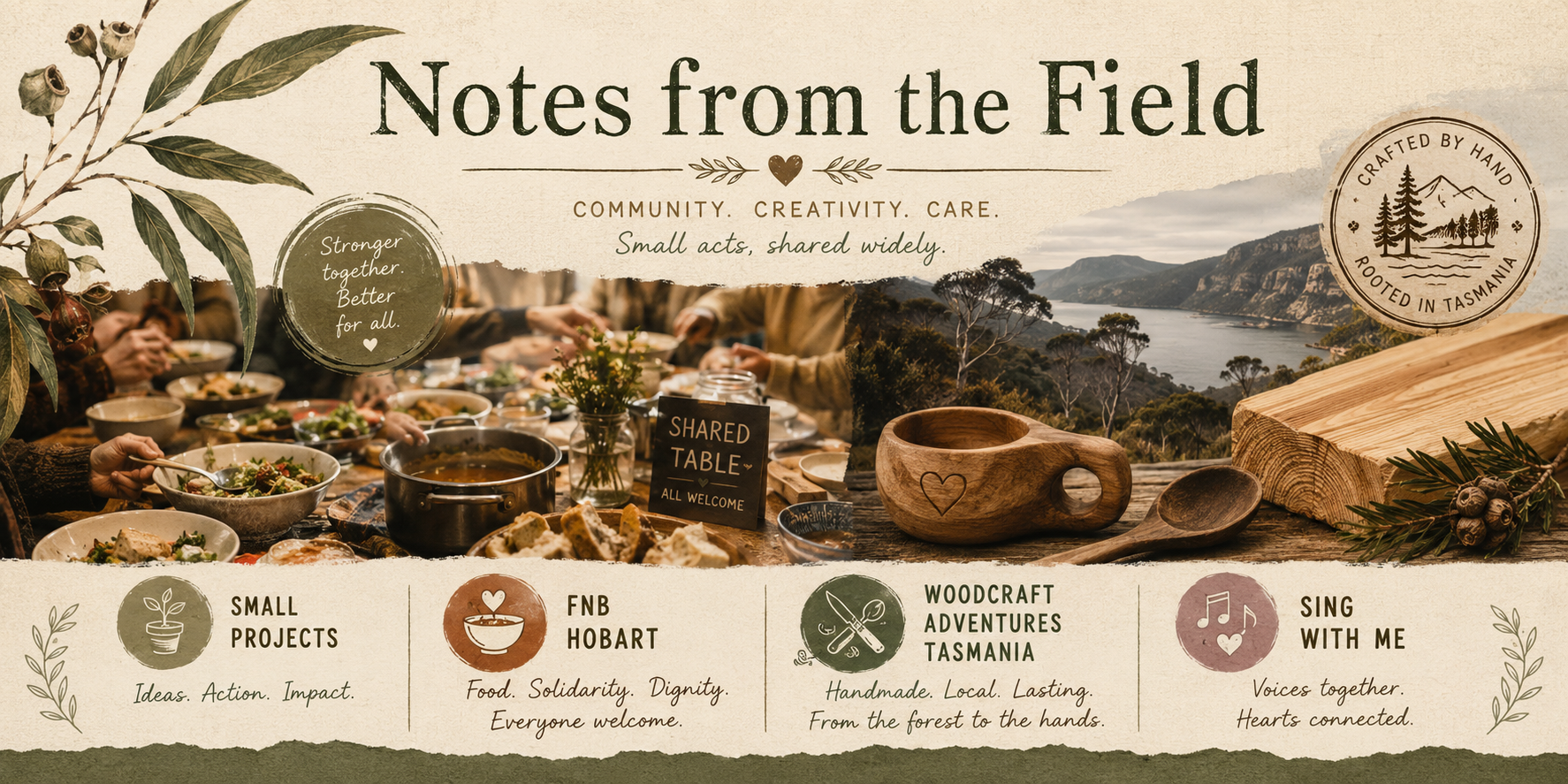
The week was quieter in some ways and busier in others. Much of my time was spent in conversations, relationships, planning, and thinking about what sustainable growth looks like for the projects around me. One theme that keeps returning is that growth only works when it is measured. More supply without the ability to distribute it well simply creates a different problem.
Food Not Bombs Hobart
OzHarvest Conversations Continue
Discussions with OzHarvest are continuing. Communication has improved significantly, with plain language being used and a clear indication of our position on the waiting list.
Around me, there are people eager to push harder. Some within my informal network remain frustrated by the loss of collections we had relied upon for many years and are exploring what avenues might exist to challenge those changes. For my part, I am taking a more measured approach.
The reality is that I am not yet ready to manage a substantial increase in supply without a corresponding increase in demand and volunteer capacity. Growth needs to happen deliberately rather than simply accepting more food because it becomes available.
Delivery Expansion Begins
While larger supply negotiations continue, demand-side expansion has already begun.
Priscilla’s Saturday evening delivery run is now supporting six families. Each delivery includes two large bags of food containing bread, meat, dairy products, fruit, and vegetables. What started as a small effort is gradually becoming a reliable community support route.
Pete and I have discussed expanding this model further. The plan is to connect with people through Food Not Bombs Hobart, assess needs through existing relationships, and then provide deliveries where appropriate. Access to meat and other higher-value foods remains an important part of making these deliveries worthwhile for families.
Church Distribution Continues to Grow
Church-based distribution expanded again this week, with significant quantities of fruit, vegetables, bread, drinks, treats, and other food becoming available.
The challenge remains not obtaining food, but matching food to people who need it. As supply grows, so does the need for systems, volunteers, and relationships that can move it effectively.
House Calls
Only one house call took place this week, visiting a Vietnamese family who continue to appreciate the support being provided.
The visit extended beyond food distribution. We spent time together socially on Sunday, strengthening the relationship. These moments are often as important as the food itself. Mutual aid works best when it is built on trust, familiarity, and genuine connection rather than transactions alone.
Sing With Me
Festival of Voices
Festival of Voices was held this week.
On Tuesday, I sang four separate times and had the opportunity to sing in St John’s Cathedral for the first time. The acoustics were remarkable, and it was a memorable experience to hear voices carry through that space.
Apart from Tuesday’s commitments, I wasn’t able to attend the other festival events. Even so, being part of the festival and singing in the cathedral was a highlight of the week.
Music continues to provide a different kind of community connection from outreach work—one built around participation, creativity, and shared experience.
Small Projects & Relationships
A significant part of my outreach work happens through conversations, meetings, and maintaining relationships.
Meeting with Eamonn
I remained in contact with Eamonn this week.
Over time, a considerable amount of support and resources have flowed in his direction. Increasingly, however, our relationship is operating on a more reciprocal basis.
Eamonn recently completed filming for a festival project, with support and resources I provided helping make that possible. As a result, we have discussed him now contributing towards one of my own projects. The principle is simple: support flows both ways.
Mutual aid is strongest when people are not only recipients but also contributors.
Visit with Doug
I also spent time with Doug.
Doug showed me work he has been doing with AI and discussed efforts connected with a history, museum, and entertainment initiative in Logan, Queensland. As always, our conversations ranged widely.
Particularly valuable was Doug’s advice regarding the broader Small Projects vision. We discussed OzHarvest strategy, communication approaches, and practical ways to position projects for long-term success. His perspective continues to be helpful as ideas move from concept to implementation.
Meeting with Pete
Pete and I continue our regular discussions around Food Not Bombs Hobart, volunteering, homelessness, food support, and the wider vision.
This week’s meeting was productive. We discussed expanding food deliveries, with a growing focus on supporting families.
Because Pete is no longer staying in shelter accommodation, Pete’s Packs are temporarily paused for a few weeks. At the same time, Pete himself remains homeless and facing the realities of winter. Some support is needed for him during this period.
Pete also provided an update regarding the ongoing “ban” situation. According to him, those affected remain unhappy with the outcome but are seeking ways to improve the situation moving forward.
Woodcraft Adventures Tasmania
More Interest from Richmond
This week we heard again from the Woodcraft Shop in Richmond, who would like us to continue presenting stock for sale through their shop. They report that sales have increased, which is encouraging news for both the shop and local makers.
Richmond has long been a destination for visitors seeking authentic Tasmanian craft. For many years, one of the village’s best-known attractions was the work of the “Wombat Man,” whose handmade wombats became something of a pilgrimage item for visiting tourists. Particularly among Asian visitors, purchasing one of his wombats became part of the Richmond experience.
Sadly, he passed away recently. His death was a significant loss for the local craft community and for Richmond itself.
Since then, we have noticed increased interest in our own wooden animal collection. While no one replaces another craftsperson’s legacy, there appears to be a continuing demand from visitors seeking handcrafted Tasmanian animal souvenirs and gifts.
For Woodcraft Adventures Tasmania, this serves as a reminder that handmade work still matters. Behind every wooden animal sold is a story, a craft tradition, and a connection between maker, visitor, and place. As tourism continues to recover and evolve, we are grateful to play a small part in that tradition.
The focus remains simple: making quality Tasmanian wooden animals and gifts that people can take home as a reminder of their time in Tasmania.
Looking Ahead
The pattern emerging is becoming clearer.
Food supply is increasing. Distribution networks are growing. Relationships are deepening. Conversations about strategy continue. Yet the challenge remains the same: building systems that can grow sustainably without losing the human relationships that make them work.
For now, the focus remains on measured expansion, supporting families, strengthening partnerships, and continuing the small projects that quietly connect people together.
— Christiaan McCann
Notes from the Field
Week Ending 12 July 2026
- Notes from the Field: Week ending Sunday 2nd August –
- Notes from the Field #No.25: Week Ending 26 July 2026 – Newsletter for Small Projects Hobart
- Notes from the Field #No.24: Week Ending 19 July 2026 – Newsletter
- Platforms: The Power of Starting with Something That Already Exists
- Psychosocial Centre: A early platform for Small Projects was based in a psychosocial centre – Visited Inside a Psychosocial Rehabilitation Centre for 15 Years
Leave a Reply