
I didn’t go looking to build a system.
I went to Deakin University to learn — and somehow ended up being asked to show what I already knew with my hands.
I was completing my field placement for my social work masters. My academic lead was Ruth, a beautiful woman from Melbourne University. She brought the structure. I brought the passion for wood.
It sat inside what was called a “community shed” — but in reality it was mostly a men’s shed. It was full of patriarchy. At the top of the hierarchy were aging men and people with capacity.
I was introduced through a program which meant I had power (at least long enough to get my program off the ground) – what happened next some might say I wasted that opportunity. I spent my time building The Cognitive Factory.
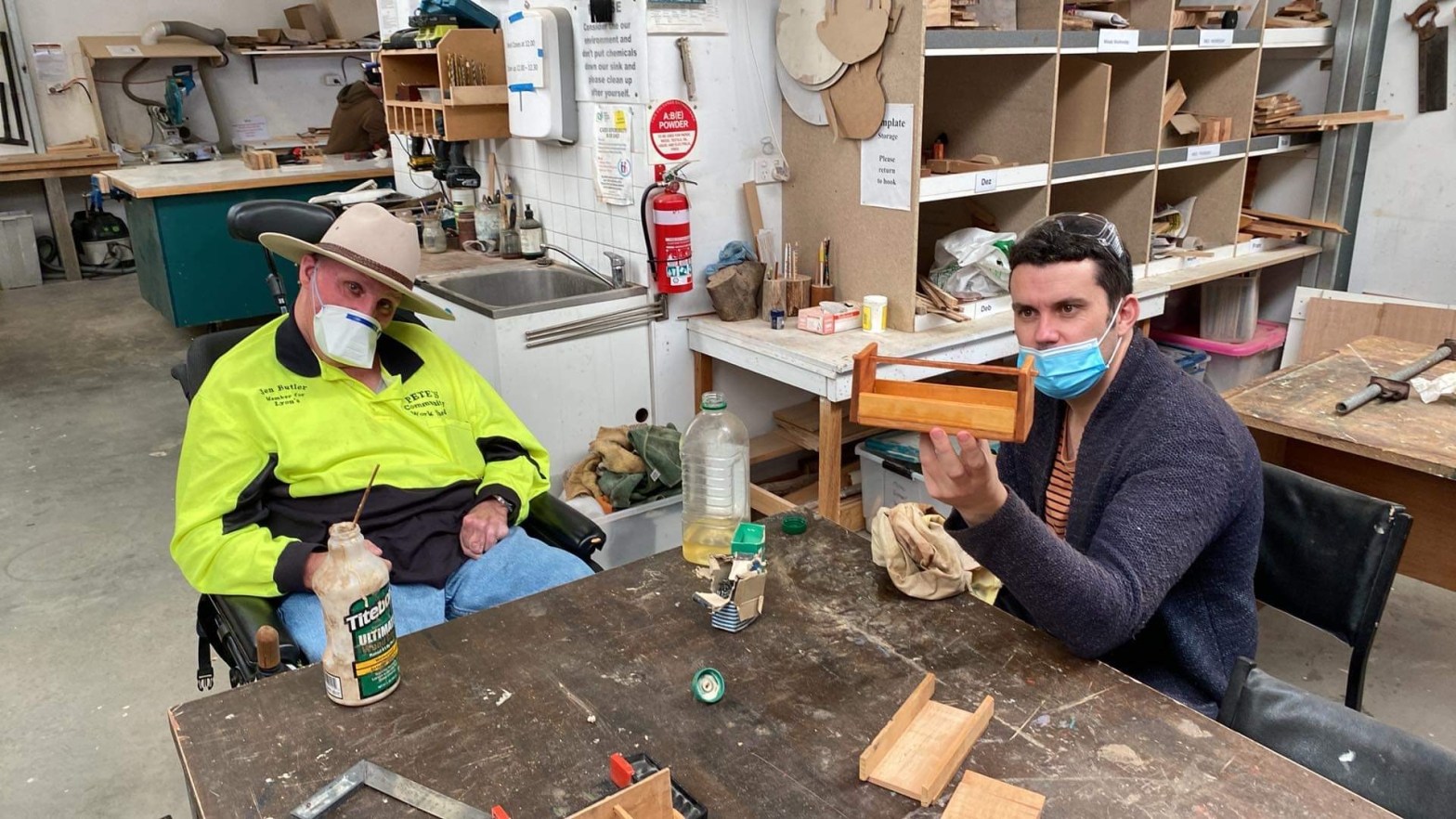
For me the important participants were people with acquired brain injuries — many from road accidents — who were trying to do woodwork. By the time I arrived, they were mostly treated as tokens. Their workers did the projects while they watched. It was entertainment for them. The leaders felt proud and expressed feelings they were doing something good.
These people were patronised. And used instrumentally to secure funding. Their program was a front and a disguise for men’s glory.
No one said it out loud, but it lived in the room:
“They can’t really do much.”
So there was a gap.
And in that gap were people — available, waiting, capable of more than anyone had bothered to test.
I stepped into that gap.
I don’t recall having a particular workshop plan – which they kept insisting on.
Because I could see something others weren’t seeing.
And I didn’t have the patience for their bureaucracy.
I didn’t start with theory. I started with wood.
I worked with those deemed lowest capacity.
King Billy Pine — soft enough that you can stand a small nail upright in it. Soft enough that a damaged arm can still win against it. I chose tack hammers — light enough for injured arms. Not to make it easy, but to make it possible.
Then I designed shapes that didn’t need to be held.
Rectangles that could lean into themselves.
Pieces that stood upright without a second hand.
So no one had to depend on someone else just to try.
The system was simple:
- Place a hammer in the hand
- Stand the nail up in the wood
- And they swing
- Hit
- Swing again
- Hit
- They never missed, who knew.
- Hear the sound
- Feel the impact
- Swing again
It was framed. It was set. It was safe enough to be wild.
Then the product making began.
Lots of noise.
Lots of motion.
We made box after box.
Then they designed. For loved ones.
It wasn’t quiet therapy.
This was bodies remembering they could move.
People watched, stunned.
No one had predicted this was possible.
No one had planned for this much life.
But I could see it before it happened.
I saw the arm capacity.
I saw what repetition could do.
I saw what wood would allow.
I don’t know why I saw it when others didn’t.
Maybe because I had once needed something like this myself.
Maybe because I trusted bodies more than systems.
My university professors watched closely. They didn’t step in. They observed — not just the participants, but me. The way experience can sometimes know things before language catches up.
Cognitive Factory wasn’t about productivity.
It was about possibility.
It proved something simple and dangerous:
That people often don’t lack ability —
They lack someone willing to design for it.
This was the moment my work stopped being just about wood.
It became about capacity.
Read another chapter:
