
Some work is visible in its results, other work is visible in its presence. The Giveaway Table belongs to the latter: a simple setup, repeated week after week, where attention, care, and dignity are offered as freely as the items on the table. These reflections notice what emerges when work begins with people rather than plans.
Some work is best understood by seeing it rather than explaining it. The Giveaway Table is one such work.
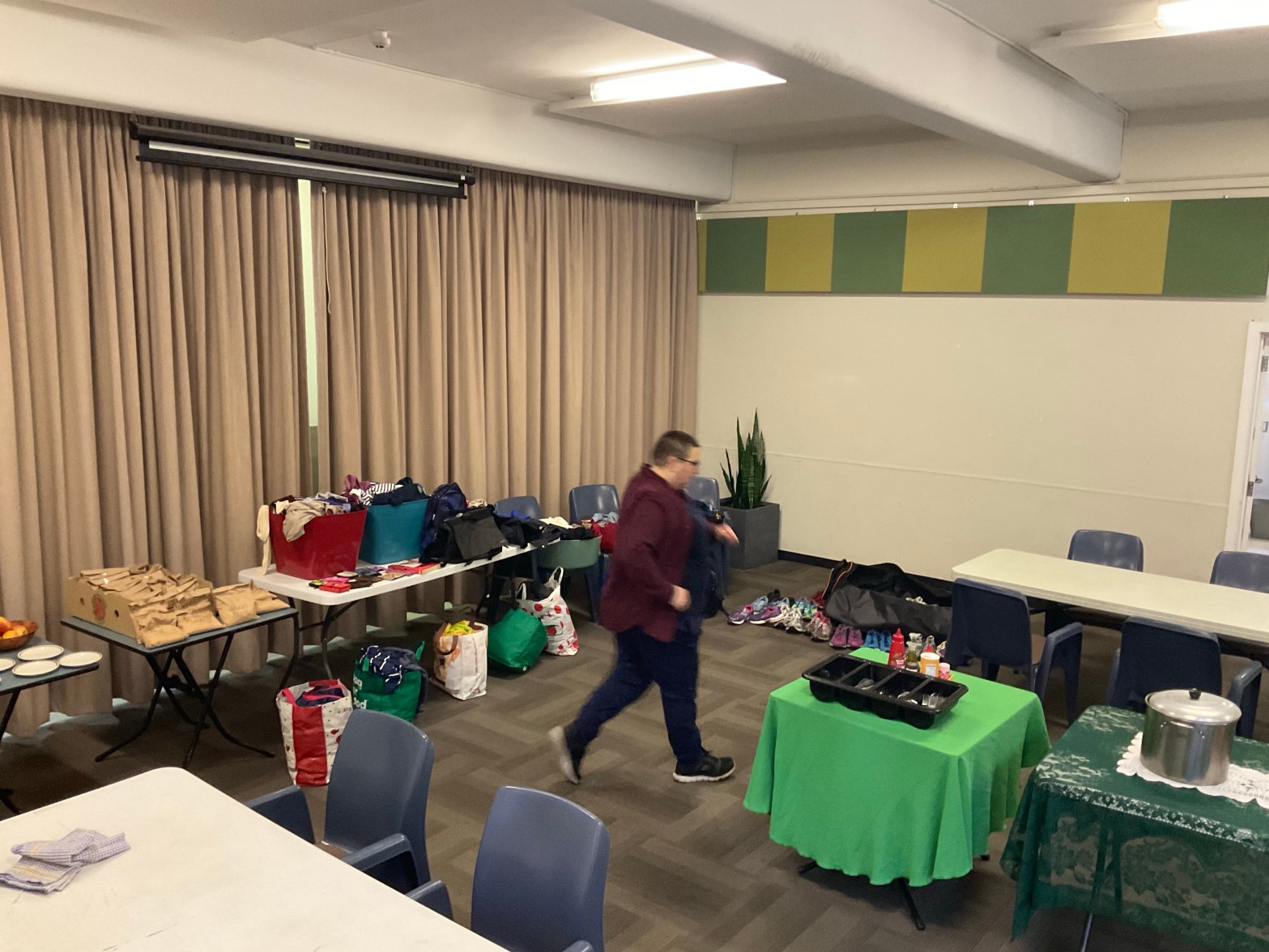
Set up each Saturday alongside Food Not Bombs, the table offers free goods to people experiencing homelessness, urban poverty, or material insecurity. It is simple by design — a table, shared goods, open hands — and intentional in posture. This is not an idea or a pilot. This is something we did, week after week, in public, with real people.
What makes it worth seeing is not its scale, but its orientation: goods shared freely, relationships held carefully, and dignity treated as non-negotiable.
What Happened
Each week, the Giveaway Table was stocked with practical items: clothing, shoes, blankets, kitchen appliances, vegan food, and other essentials. People arrived in different ways. Some came for the Food Not Bombs meal, some for the table, some for both. There was no single entry point and no requirement to explain need.
People moved at their own pace. Conversations emerged naturally. Decisions about what to take were made by participants themselves.
Behind the scenes, the work involved attention and care: sorting donations ethically, responding to patterns of need, coordinating with others present, and making real-time judgments about fairness and access. The table functioned not as a distribution line, but as a shared space — one where people were recognised rather than processed.
What It Taught Us
The Giveaway Table taught us that meaningful work does not require complexity, but it does require presence.
Giving freely is not frictionless. It raises questions about scarcity, fairness, boundaries, and trust. It challenges assumptions about who controls resources and how value is measured. Yet when handled relationally, those tensions become sites of learning rather than failure.
Again and again, we saw that being seen mattered as much as what was received. People lingered. They spoke. They returned. The table became familiar — not because it promised outcomes, but because it held attention.
Across this and other work, a consistent principle emerged: presence comes before program; invitation comes before outcome.
Reflection on Microenterprise
While the Giveaway Table did not generate income, it functioned as a charitable microenterprise in practice.
It redistributed resources locally.
It cultivated participation rather than dependency.
It operated without hierarchy, branding, or institutional distance.
Importantly, it also revealed a pathway: this kind of work could be stewarded by a person — someone whose role is to gather, curate, distribute, and hold relationships — as a meaningful form of work shaped by care rather than productivity metrics.
In that sense, the table points toward a broader imagination of microenterprise: one where economic activity, charity, and dignity are not separated, and where small-scale work can still be real work.
Closing Reflection / Invitation
The Giveaway Table is part of seeing our work because it shows what happens when we start with people rather than plans.
It is not a model to replicate exactly, nor a solution to scale. It is a posture worth noticing: work that begins with attention, offers freely, and builds trust one table at a time.
For those exploring ethical microenterprise, charitable work, or forms of livelihood grounded in relationship, the Giveaway Table offers a lived example — quiet, imperfect, and real.
