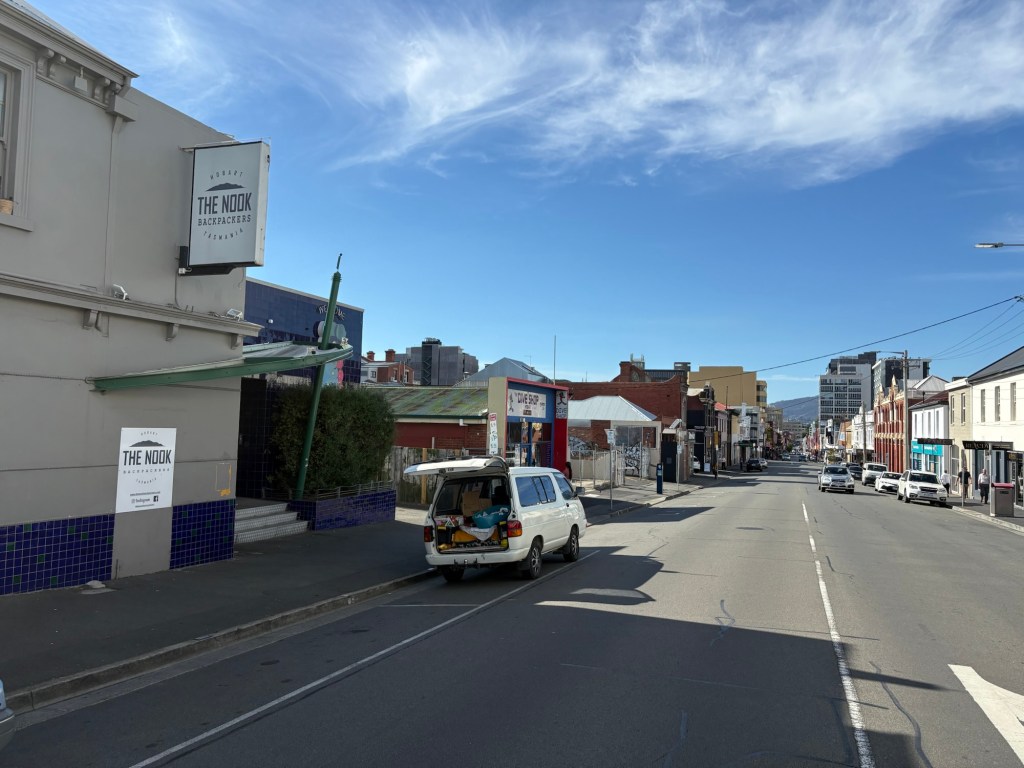
There’s something about the way Eamonn moves through the city that tells you he’s learned the rules the hard way.
Not the official rules—the ones written on forms or spoken in offices—but the quieter ones. The survival rules. The ones you only pick up when life narrows.
Eamonn lives in short-term accommodation in the city. “Short-term” has that polite, temporary ring to it, but the reality feels more like suspension. Not quite landing, not quite leaving. Life, for him, seems to orbit around coping—getting through the day, stretching what little there is, staying afloat without ever quite reaching shore.
Money is tight. A few spare dollars here and there, but never enough to relax into. And yet, what stands out isn’t scarcity so much as the resourcefulness it breeds. Necessity sharpens instinct. You see it in small moments—like the way he approached the free supplies in my van. No hesitation, no second-guessing. Just a kind of practiced awareness: this is available, this is part of how I survive.
There’s no shame in it. In fact, there’s almost a quiet confidence. A sense that this is not only normal, but necessary. That being alert, even a little competitive for resources, is healthy in this world. It’s not greed—it’s adaptation.
Life, as he describes it, splits into two domains: inside and outside.
Inside is the unit. Contained, functional, impersonal. A place to exist.
Outside is everything else—the movement, the people, the culture. When Eamonn talks about the outside, his voice shifts. Suddenly there’s an itinerary: art shows, underground scenes, people you might know if you were in that world. A kind of social map of the city that feels alive, connected, almost glamorous in contrast.
Sitting with him, you get drawn into that rhythm. Conversations about who’s going where, who’s meeting who, the buzz of new encounters. There’s excitement in it—real excitement. But there’s also something else, just beneath the surface.
It feels like a constant reaching.
Like the importance isn’t just the event or the person, but the fact of having someone—anyone—to meet. Someone to talk to. Someone to share a moment with, even if that moment quickly turns into talking about something else. Often anything else.
And it makes you wonder: what happens to intimacy when private space disappears?
When your “inside” is shared, temporary, or thin-walled, maybe intimacy doesn’t live there anymore. Maybe it gets pushed outward, into conversations with strangers. Into these fleeting, socially agreed-upon pockets of connection—brief moments where two people create a sense of privacy in public, just long enough to feel human together.
But those moments don’t last.
And so you keep moving.
When I sat down with Eamonn more formally—what you might call an interview, though it didn’t feel like one—I noticed another layer. There was a kind of performance happening. Not in a false way, but in a structured one.
The conversation leaned upward. Positive. Light. Almost rehearsed.
It felt like there were unspoken rules about how to present life. That you keep it social, keep it upbeat, keep it moving. And the more I looked around—the small space, the shared kitchen, the unused social nook—the more that performance made sense.
Because the environment itself didn’t offer much to be positive about.
Except, perhaps, in the most existential sense: I am here. I exist. I made it through today.
And maybe, in some quiet calculation, that’s enough to keep going. Enough to say, “I’m not likely to disappear tomorrow.”
There was mention of monthly meetings with a psychiatric board. A check-in. A moment of oversight. Then back out again.
It raises questions.
Is this what support looks like now? A brief intervention, then release? A system that stabilises just enough, then steps back? There’s a sense of being managed at a distance—kept within bounds, but not truly held.
Not accompanied.
And sitting there, listening, observing, you can’t help but ask where you fit into all of this.
Because you’re not part of the system.
But you’re not outside it either.
You’re in the in-between space—offering a ride, sharing resources, having conversations that stretch a little deeper than the usual script. Not a professional intervention, not a passerby. Something more human, less defined.
Maybe that’s the point.
In a life shaped by coping, where systems are intermittent and spaces are temporary, what stands out are these unscripted connections. Moments where someone isn’t performing, or competing, or moving on—but simply being seen.
Even briefly.
Even imperfectly.
And maybe for Eamonn—and for you—that’s not everything.
But it’s not nothing either.
- Coping in the In-Between: A Day with Eamonn
 Eamonn lives in short-term accommodation, where life narrows to survival, resourcefulness, and fleeting connection. In a world split between “inside” and “outside,” intimacy becomes temporary, support feels distant, and coping becomes a way of life.
 - Notes From The Field: Sunday, 29th March 2026. The newsletter where intentions meets reality.
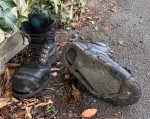 Notes from the field this week: We often think we know what people need. This week proved otherwise—through a pair of boots, a small room, and stories that don’t fit neatly on the surface.
 - Chapter XX – The Big 66 KEYSTONE INITIATIVES My six charitable initiatives demonstrate a commitment to social impact, community building, and individual empowerment. FOOD NOT BOMBS HOBART Nourishing Community, One Meal at a Time Join us at Food Not Bombs, a volunteer-powered soup kitchen dedicated to serving up delicious, nutritious meals to those in need. Our mission is simple: to… Read more: Chapter XX – The Big 6
- Chapter 50: Woodcraft Adventures. A business start-up for people with a disability.
- Chapter 30: Building a social enterprise.
 “Business is the salt of life” Voltaire, French Writer, Historian and Philosopher “Salt heals” Christiaan McCann, Microenterprise Builder What I Do Welcome to Microenterprise Builder. This is about my project building microenterprises for people locked out of the system. I’m excited to introduce a new initiative that combines my passion for arts and crafts, business… Read more: Chapter 30: Building a social enterprise.
 - Chapter – appendix: WOODCRAFT ADVENTURES: Introducing Personalised Treasures Collection. Customised items that make thoughtful gifts or keepsakes.Personalised Treasures Collection Personalised Treasures Welcome to Personalised Treasures, where your unique desires become tangible keepsakes. It’s about embracing the courage to ask for exactly what you want. Imagine having a custom-made sign that reflects your personal style, crafted from beautiful Huon pine wood. You envision clear block lettering, simplicity, and elegance, with holes in… Read more: Chapter – appendix: WOODCRAFT ADVENTURES: Introducing Personalised Treasures Collection. Customised items that make thoughtful gifts or keepsakes.
- Chapter – appendix: WOODCRAFT ADVENTURES: Introducing Functional Creations Collection. Woodcraft items designed for practical use.Functional Creations Collections Functional Collection List Product Deal Our BIGGEST SPATULAS SALE EVER BUY 2 GET ONE FREE Sale $50 for Set of 3 Free pocket-sized spatula on purchase of the pot and pan spatula Functional Creations: Where Purpose Meets Craftsmanship Handcrafted with precision and care, our functional creations embody the perfect union of form… Read more: Chapter – appendix: WOODCRAFT ADVENTURES: Introducing Functional Creations Collection. Woodcraft items designed for practical use.
- Chapter 30: Building a social enterprise
 Building a social enterprise
 - Chapter 80: Meet PriscillaMeet Priscilla
- Notes from the field: Newsletter no. 7, 22nd March 2026 – Hands That Give, Hands That Receive
 A simple act—a meal shared, a song sung, a carving gifted—can ripple further than we expect. This week, generosity turned into movement.
 - When Outreach Feels Like Failure (But Isn’t)
 Outreach doesn’t always look like impact. Sometimes it looks like showing up, again and again, with nothing obvious to show for it— and trusting that something deeper is still taking place.
 - Eamonn’s Podcast “The Dirt”: Telling stories about living on the streets of Hobart.
 Get ready to dig into the heart of our community with ‘The Dirt’ podcast! Join us as we hit the streets to uncover the untold stories, hidden gems, and unsung heroes of our country town. From the voices of local youth to the wisdom of community leaders, we’re sharing the real stories that make our… Read more: Eamonn’s Podcast “The Dirt”: Telling stories about living on the streets of Hobart.
 - Christiaan’s Musical Mission: Welcome Blog! Singing For Others.The Power of Music in Community: Stories of how music has affected the lives of people experiencing isolation Music can slip past walls. It bypasses both the ones we build around ourselves and those life puts in our way. In community spaces, especially among people living alone or feeling cut off, a single song can… Read more: Christiaan’s Musical Mission: Welcome Blog! Singing For Others.
- Food Not Bombs Hobart
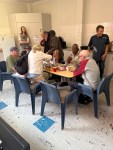 Food. Dignity. Community. There’s a place in Hobart where food is shared freely. No transactions. No eligibility checks. No questions about whether someone deserves it. Just food—and people. What This Is Food Not Bombs Hobart is a simple idea lived out week by week: Food that would otherwise go to waste is collected, prepared, and… Read more: Food Not Bombs Hobart
 - Community Dinner Past Website.In the heart of Hobart, a revolutionary movement is underway, as Food Not Bombs Hobart works tirelessly to combat food waste and feed the community, one delicious and nutritious meal at a time. The Story Behind Food Not Bombs Hobart: Our Mission and Vision We are a social political organisation. We exist because of the… Read more: Community Dinner Past Website.
- Community Dinner Building Application 2024.This blog is what I wrote for my application to council for the: Hobart City Council Support Program for Food Not Bombs at Criterion House. 1. What is the name of the program that you deliver at the City of Hobart venue? Food Not Bombs Hobart 2. What support does your program provide to the community?… Read more: Community Dinner Building Application 2024.
- Eamonn: Artist For Sale.Unleashing Creative Vision Introducing Eamonn Miller, and Handsome Arts, a microenterprise dedicated to promoting the innovative work of Eamonn Miller, a talented filmmaker and painter. The mission is to empower Eamonn Miller to share their unique perspective with the world, and build a successful career in the arts. Through this microenterprise, we will: Join in… Read more: Eamonn: Artist For Sale.
- Newsletter 6 (or Letters from the field): 15th March 2026 – ChristiaanMcCann.Com
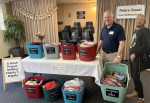 This week I watched Pete run the free clothes store again. He lays the clothes out carefully, almost like a small department shop — jackets together, shirts folded, shoes lined up. People arrive and begin browsing. For a moment it looks completely ordinary. Except everything is free.
 - Pete’s Free Clothes Store
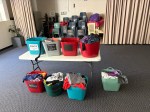 Pete runs a free clothes store for people doing it tough. What started as sorting donated clothes turned into something bigger — leadership and mutual aid.
 - My Story: Family roots.
 Birth I was born at the Mercy Women’s Hospital, East Melbourne. I respectfully acknowledge the Traditional Owners, on the land where I was born, the land of the Wurundjeri Woi Wurrung and Bunurong Boon Wurrung, people of the Eastern Kulin nation. And I pay my respect to their Elders past, present and emerging. On this… Read more: My Story: Family roots.

Leave a comment